Skip to content

For teams that keep the rules, the memory and the record

Open-source private AI for business, kept as files

The open-source AI Operating System

Private AI for business comes down to where the agent's rules, memory and history live, as much as where the model runs. Kortix is the open-source AI Operating System. In it, every agent, skill, rule, connector and piece of context is a file in one git repo.

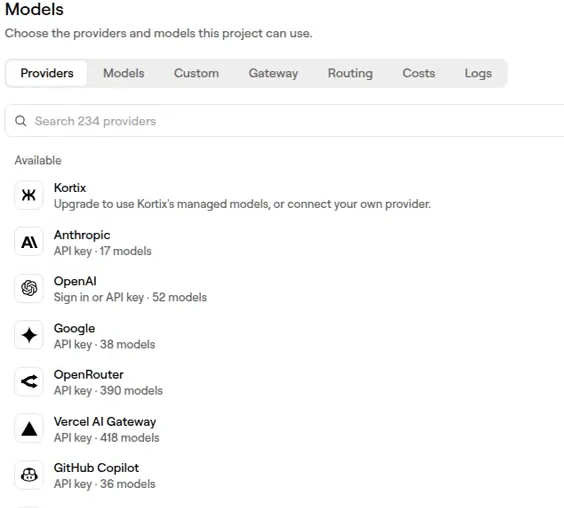
Kortix project Models screen: the Providers list, where Anthropic, OpenAI, Google, OpenRouter, Vercel AI Gateway and GitHub Copilot are each connected with your own API key.

Any model provider with your own keys. Or the ChatGPT plan you already pay for.

Source: kortix.com

kortix.yaml

connectors:
  - slug: linkedin
    provider: composio
    policies:
      - match: "linkedin.create_*"
        action: require_approval

Three shapes of private AI, and what each one rents

The model is one decision; the rules, the memory and the record are the other three

Model in your VPC

The model runs inside the perimeter. The working knowledge does not.

Inference stays on your network, while the prompts, the rules and the history that make the model useful sit in the vendor's product.

What the review foundacme-private-ai-review.md
Model endpoint
your VPC
Agent definitions
vendor console
Session history
vendor database
Export path
support ticket

Acme's deployment review, one page

Vendor workspace

Encrypted, and still their workspace.

A hosted private workspace encrypts what it stores and keeps the SOPs, the skills and the run history inside its own product.

What the review foundnorthwind-workspace-review.md
Encryption at rest
yes
SOPs edited in
their builder
Skills and prompts
their library
Run history
their database

Northwind's procurement note, one page

Self-hosted

The rules are files you can diff.

Self-host Kortix with one Docker Compose stack and the agents, skills, memory and connectors come as files in a git repository on your server, with the approval rules in the same file.

What the review foundkortix.yaml
+3 −0
connectors:- slug: linkedin+    policies:+      - match: "linkedin.create_*"+        action: require_approval

One change request, reviewed by a person

What each shape leaves in your hands

Kortix, Prem AI and VDF AI, on the six questions a private AI decision turns on

Open source
Yes. Read it, fork it, audit it.
Self-hosting options
Kortix Cloud, your VPC, or on-prem. Self-host is free.
Where agent work runs
Sessions run on Platinum sandboxes, not on the server.
Where the rules live
In kortix.yaml, in the repo you own.
Approvals and audit
Approval gates you set. Off until you set them.
Pricing model
Free $0, 500 credits per month; credits from $50 a month.
Open source
Not published.
Self-hosting options
Not published.
Where agent work runs
On Prem's infrastructure, attestation at every layer.
Where the rules live
In Fluso's no-code agent builder.
Approvals and audit
Not published.
Pricing model
No public price; a demo request.
Open source
Not published.
Self-hosting options
On-prem, private cloud, sovereign air-gapped.
Where agent work runs
Agents, language models, retrieval and orchestration run inside your own infrastructure.
Where the rules live
In VDF's skills and workflow editors.
Approvals and audit
Access controls, execution logs and audit trails.
Pricing model
On-prem annual seat bundles; cloud plans from $20.

Each rival cell is what that vendor's own pages say, read 29 October 2026. Where the limit sits: agent sandboxes run on the compute provider you configure, and the instance stays reachable so they can call back, so the isolated machine is rented even when the operating system is not.

What stays on your disk

The three answers a procurement review asks for first

Data on disk

When you self-host, the database, the files, the repos, the secrets and the audit record all sit on disk you control.

Approval gates

Approval gates you set. Off until you set them.

Audit record

Every action is recorded. Reading, exporting and streaming the audit log depend on the plan.

What buyers ask before a private deployment

Short answers, with the limits named

Not entirely. Every agent runs somewhere, so private means owning the files and the record while the compute stays rented. When you self-host Kortix, the database, the files, the repos, the secrets and the audit record sit on your disk; the sandboxes run on the compute provider you configure.

A rule of thumb with no legal force: AI takes about 70% of repetitive, data-heavy work and people keep 30% for judgement and approval (Intersog's definition). Private AI only holds that split when the approval step and the record sit in the system that runs the agents.

The one whose files, memory and bills you can take away. Start on the Free plan, $0 with 500 credits per month on your own provider keys. Self-host is free.

It depends on what you rent. Self-hosting the Kortix platform is free; you pay for the server, the model calls and the sandboxes. On Kortix Cloud, Free is $0 with 500 credits per month and paid credits start at $50 a month.

Own the operating system, rent only the compute

Run Kortix on its cloud, in your VPC, or on your own server, and keep the files either way.